

Overview
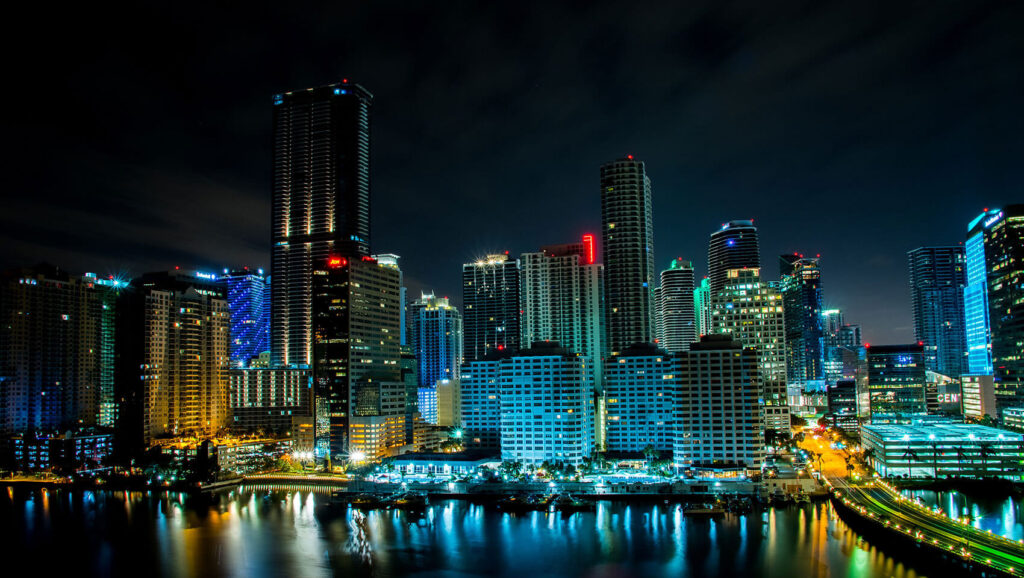
Downtown Miami is the city’s point of origin and, today, one of its most strategic hubs. Here, history and verticality coexist, connecting finance, culture, entertainment, and housing in a single territory. Integrated into it, the Arts & Entertainment District expands this vocation by uniting arts, museums, and major urban projects along the bay.
It’s a neighborhood of convergence: people, capital, and ideas circulate at a constant pace, sustaining a dynamic and global urban market.
History & Identity
The birth of Downtown is directly linked to the founding of Miami in 1896, with the arrival of Henry Flagler’s railroad. For decades, the area concentrated commerce, banks, and public institutions, shaping the city’s economic center.
Beginning in the 1990s, the neighborhood began a process of profound transformation. Old commercial buildings gave way to residential towers, hotels, and cultural centers, redefining Downtown as a mixed-use environment. The Arts & Entertainment District emerged in this context, consolidating a new urban identity based on culture, design, and metropolitan scale.
Architecture & Urban Planning
The region’s architecture is marked by contrast. Historical icons like the Freedom Tower coexist with contemporary projects designed by internationally renowned names. Residential towers and mixed-use developments redefine the skyline with a modern language and a focus on intelligent density.
Projects such as Miami Worldcenter , One Thousand Museum , Paramount Miami Worldcenter , and Waldorf Astoria Residences represent a new urban phase in which housing, leisure, hospitality, and public spaces are integrated in a structured way.
Culture & Lifestyle
The Arts & Entertainment District is home to some of the city’s leading cultural institutions, such as the Perez Art Museum Miami (PAMM) , the Frost Museum of Science , and the Adrienne Arsht Center for the Performing Arts . These spaces position the area as a cultural hub of international importance.
The lifestyle is urban and diverse. Award-winning restaurants, global events, bayside parks, and a vibrant cultural scene attract residents, creatives, executives, and investors seeking centrality and immediate access to the city.
Location & Mobility
Downtown boasts one of Miami’s best mobility infrastructures. The neighborhood is served by the Metromover , a free system that connects Downtown, Brickell, and strategic areas of the city. It also houses Metrorail and Brightline stations , linking Miami to other cities in Florida.
Its proximity to PortMiami , the airport (approximately 12 minutes away), and major access roads reinforces its role as a logistics, tourism, and corporate hub.
Real Estate Market & Key Data
The average value of condominiums in Downtown is around US$620,000, with high-end units ranging from US$1.2 million to over US$10 million. In the last decade, the accumulated appreciation has exceeded 90%, with an average annual growth of close to 7.5%.
Rents average approximately US$3,700 per month, with occupancy rates above 94%, generating yields between 4% and 6%, especially in new and well-located buildings.
Investment Profile
Downtown & Arts District attract investors seeking:
- Centrality and connectivity
- Strong real estate liquidity
- Residential and corporate demand
- Appreciation driven by large urban projects.
- Exposure to international events and capital.
It is a mature urban market, supported by infrastructure, culture, and scale.
Market Behavior
An urban growth core with typical home values near $517,000 and a high concentration of Latin American investors (99%); despite a 5% value correction as the market stabilizes, it offers a “safe harbor” for institutional capital through Class A multifamily assets and proximity to multi-billion-dollar transit infrastructure.
Reading The Miami Deal
In The Miami Deal, we interpret Downtown and the Arts & Entertainment District as the point of equilibrium between origin and future. A territory where strategic decisions require a precise understanding of context, time, and urban vocation.
Here, investing means understanding the rhythm of the city and positioning yourself where culture, capital, and mobility meet.